
Advancing Remote Control Technology for Compact Equipment Manufacturers
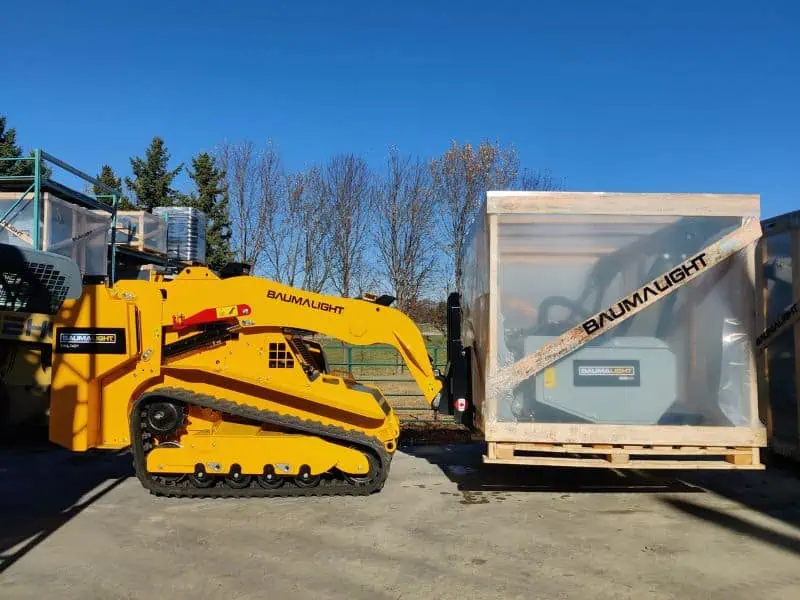
Compact equipment manufacturers face growing pressure to integrate advanced control technologies in an era of increased automation and safety demands. However, such systems’ development and deployment often exceed smaller OEMs’ resources. Cattron’s collaboration with Baumalight, a Canadian mini skid-steer manufacturer, provides an exemplary roadmap for how compact equipment can integrate sophisticated remote control and engine management solutions, enabling smaller players to compete in an evolving marketplace.
The Challenge
Baumalight aimed to respond to customer requests for remote operation for the new TRL740 mini skid-steer series. This initiative followed upgrades to its existing TRL620 model, featuring enhanced power systems, expanded hydraulic capacity and a reinforced frame. Developing in-house remote control capabilities posed significant technical and financial challenges, prompting Baumalight to partner with Cattron.
A Collaborative Two-Phase Integration Process
Phase One: Engine Management Integration
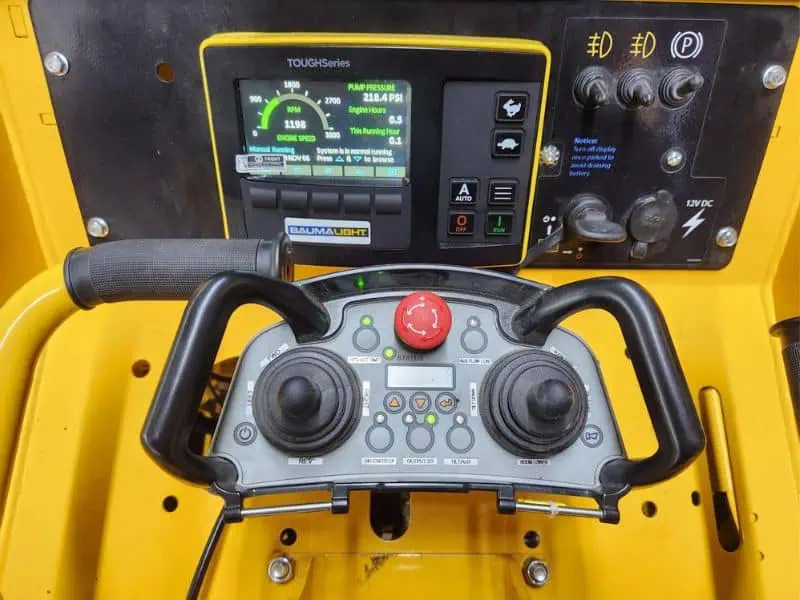
Baumalight transitioned from manual control to advanced engine control with a DynaGen™ PRO600. This ruggedized controller, compatible with CANbus and Modbus protocols, enabled precise engine and system management, offering advanced monitoring and predictive maintenance capabilities.
Phase Two: Remote Control Implementation
The CattronControl™ LRC-S1 radio remote control system integrated a dual joystick bellybox, the CBMCU receiver, a docking mechanism for seamless local or remote operation and IP65-rated durability for harsh environments. Baumalight elected to private label the remote control system, visually extending their brand on the mini skid-steer.
Engineering Innovation
The integration demanded extensive mechanical, electrical and hydraulic modifications, including:
- Transitioning from manual to electric-over-hydraulic systems with proportional control valves.
- Custom wiring harnesses were developed to be compatible with Yanmar and Kubota engines.
- Implementing adaptive control algorithms for temperature and load variability.
Performance Enhancements
Operators reported improved machine responsiveness and precision compared to previous manual hydraulic systems. Real-time monitoring of hydraulic and engine parameters, alongside diagnostic data logging, further optimized system efficiency. The modular system design also ensures scalability for other equipment categories, such as stump grinders, mobile buckets and portable generators.
Enhanced Safety Features
Safety was a primary consideration in designing the system, but it goes beyond basic emergency stop functionality. The LRC-S1’s remote control capability allows users to maintain a safe distance when handling hazardous materials or working in dangerous environments. Its redundant CANSafe architecture ensures reliable operation, and while the system’s optional tilt detection feature was not part of the initial skid-steer upgrade, the option can add an extra layer of protection for those operating on uneven terrain.
The docking system, which allows seamless transition between local and remote operation, required additional attention to safety protocols. We implemented redundant position sensing and automatic mode switching, ensuring operators cannot inadvertently activate remote functions during on-vehicle operation.
Market Impact

Integrating remote control capabilities positioned Baumalight to meet customer demands, including applications in hazardous environments. After viewing demonstrations, a large Pennsylvania-based landfill ordered the machine, heavily valuing the remote control capability for handling dangerous materials.
The technology’s benefits extend beyond skid steers, offering benefits to a wide range of construction equipment, from stump grinders, buckets, and winches to compact concrete pumps and cranes. The safety applications extend to heavy equipment like dozers and wheel loaders, where remote emergency stop capabilities provide an added layer of protection.
Future Outlook
This collaboration underscores how smaller OEMs can adopt advanced control technologies without prohibitive costs. Cattron’s modular, scalable systems allow manufacturers to enhance equipment functionality and safety, broadening market competitiveness. Because of the rapid market validation, Baumalight has standardized its production line with the DynaGen PRO600, with remote control available as an option.
Conclusion
The Cattron-Baumalight partnership exemplifies how systematic engineering and collaboration can democratize access to cutting-edge technology. Cattron offers an integrated approach to equipment control, combining radio remote control, engine management and telemetry capabilities. This case study serves as a blueprint for similar integrations, proving that advanced remote control systems are no longer the exclusive domain of large manufacturers.