
Smart Monitoring Solutions Transform Landfill Operations
U.S.-Based Waste Management and Recycling Company

Background
A major U.S. waste management and recycling company operating several landfills across multiple midwestern states has transformed its environmental monitoring capabilities by implementing Cattron’s advanced remote monitoring and control solutions. The company’s largest facility, processing over one million tons of waste annually across hundreds of acres, exemplifies how modern automation technology can enhance operational efficiency while ensuring environmental compliance.
Landfill Leachate Collection Systems
Operational Challenges
The company faced several critical operational challenges in monitoring and managing its landfill leachate collection systems. Some of the landfill’s existing monitoring infrastructure relied on point-to-point radio communications, which proved problematic due to the dynamic nature of landfill operations, with constantly changing topography as waste accumulates, disrupted line-of-sight signals between monitoring stations and the impact of weather-related factors.
Additionally, the company operated with multiple monitoring systems and programmable logic controllers (PLCs) from various vendors across their different facilities, a common situation as they continued to acquire new landfill operations. While these systems functioned effectively, bringing all the data to the cloud and standardizing monitoring across facilities presented a technical and cost challenge. The disparate nature of the systems meant maintaining multiple platforms, interfaces and reporting methods, which complicated efforts to achieve unified monitoring and real-time data access across all locations. A cloud-based solution would provide more efficient data management and streamlined regulatory compliance reporting while reducing the need for specialized technical support at each facility.
Cattron Integrated Solutions
After evaluating various options, the company selected Cattron’s integrated solution to modernize its landfill monitoring operations. The combination of advanced hardware and cloud-based software provided a comprehensive approach to environmental monitoring that offered distinct advantages over traditional systems while remaining cost-effective compared to full-scale Supervisory Control and Data Acquisition (SCADA) implementation.
Aquavx™ Remote Monitoring Devices
The Aquavx™ remote monitoring devices are the system’s foundation, providing robust data collection and control capabilities at each monitoring point. The devices can interface with virtually any sensor type, from basic-level transducers to sophisticated chemical monitoring equipment. This flexibility allows the company to monitor everything from pump operations and flow rates to power consumption and leachate composition. The Aquavx™ ProPlus units are particularly valuable for their cloud-based peer-to-peer networking capabilities, which enable automated coordination between Aquavx units without requiring complex programming or specialized maintenance.
RemoteIQ™ Water Cloud Platform
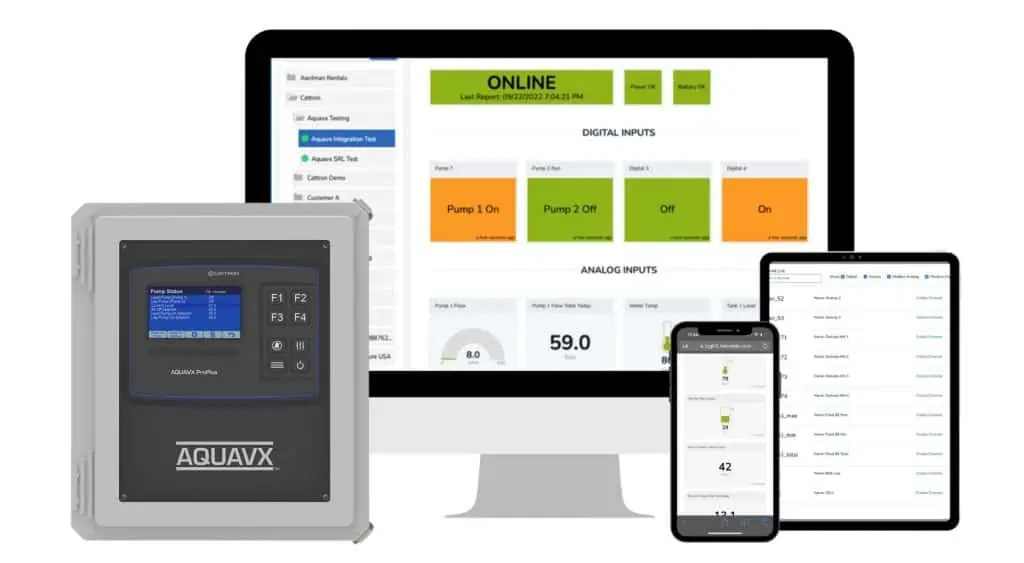
The RemoteIQ™ Water cloud platform transforms this collected data into actionable intelligence, providing a centralized management interface accessible from anywhere. As a purpose-built solution for water and wastewater applications, RemoteIQ offers sophisticated features like customizable dashboards, automated regulatory reporting and configurable alarm notifications. The platform’s architecture ensures data security while enabling seamless integration of new monitoring points as operations expand. Perhaps most importantly, RemoteIQ eliminates the need for on-site servers and complex networking infrastructure, significantly reducing initial investment and ongoing maintenance costs.
The most significant improvement came from the system’s innovative approach to communications. Rather than relying on traditional radio communications, the solution leverages cellular networks and cloud connectivity. This approach eliminates line-of-sight requirements and provides consistent connectivity regardless of changing landfill topography. The peer-to-peer networking capability allows multiple Aquavx units to communicate through the cloud, enabling automated coordination between monitoring points and control systems.
The system’s comprehensive monitoring capabilities extend far beyond basic measurements. The solution continuously tracks leachate storage tank levels, providing real-time data on fluid levels and trends. Pump operation monitoring includes detailed performance metrics such as run times, cycle counts and operational status. Flow monitoring encompasses instantaneous flow rates and cumulative flow volumes, providing valuable data for operational planning and regulatory compliance.
The system also monitors critical infrastructure elements, such as power supply status, and can alert operators to power failures or irregularities. Temperature monitoring of leachate helps prevent system damage and ensures proper operation, while pH level monitoring and other chemical parameters can be incorporated to meet regulatory or operational needs.
Advanced Control Features

The system’s automation capabilities prove particularly valuable in leachate management operations. The solution enables redundant, automatic pump control based on tank levels. When monitoring parameters exceed safe ranges, automated shutdown procedures protect equipment and prevent storage tank and pond overflows. Operators can manually override automatic controls remotely, providing flexibility for special circumstances or maintenance operations.
The RemoteIQ cloud platform is the cornerstone of the system’s management capabilities. This centralized interface allows operators to monitor all facilities from a single dashboard, eliminating the need to access multiple systems or physically visit sites for routine monitoring. The platform provides real-time data and historical trends, enabling operators to identify patterns and potential issues before they become problems.
The system’s notification capabilities ensure that appropriate personnel are immediately informed of any issues or concerns. Operators can configure automated alerts based on multiple parameters, ensuring rapid response to potential problems. The platform also streamlines environmental compliance by automating custom regulatory report generation, reducing the time and effort required for documentation while improving accuracy.
Implementation Process
The company adopted a methodical, phased implementation approach, initially deploying the solution at seven facilities. This careful rollout strategy allowed them to refine their implementation process and address any challenges before expanding to additional sites.
At locations with existing infrastructure, Messenger 600 units, already part of the existing infrastructure, provided a bridge between legacy PLCs and the new system. This integration capability allowed for gradual migration while maintaining operational continuity. For simpler monitoring points requiring only one or two inputs, the company deployed lower-cost Messenger W units.
The implementation strategy focuses on standardizing operations across all facilities while maintaining flexibility to address site-specific requirements. This balanced approach allows the company to maintain continuous operations during migration while minimizing disruption to existing processes. The phased implementation also enables more effective staff training, allowing personnel to gradually become comfortable with the new system.
Operational Impact
The deployment of the remote monitoring solution has fundamentally transformed the company’s operations. Manual monitoring requirements have decreased significantly, freeing staff for other essential tasks. The automation of data collection and reporting not only saves time but also improves accuracy and consistency. Maintenance procedures have become more streamlined, with many issues now identifiable and resolved remotely.
Environmental compliance has improved substantially through real-time monitoring of critical parameters and automated regulatory reporting. The system enables faster response to potential environmental issues, often allowing problems to be addressed before they become significant concerns. The system’s comprehensive documentation and record-keeping capabilities provide better protection against compliance issues.
The solution has delivered measurable cost savings through reduced maintenance requirements and decreased need for specialized labor. The risk of environmental incidents has diminished, and existing staff can work more efficiently through the streamlined monitoring and control systems.
Future Outlook
The company’s plans for system expansion include extending the solution to its remaining facilities and exploring additional capabilities. Integration of IP cameras for visual monitoring will provide another layer of operational oversight, while weather station integration will help predict and manage rainfall or temperature-related impacts on operations.

Particularly exciting are the possibilities for artificial intelligence and machine learning applications. The company envisions using these technologies for predictive maintenance, early warning of potential system issues and optimization of pump operations. Weather event impact prediction could help manage leachate storage and processing more effectively.
As the system evolves, it will incorporate more sophisticated weather integration features. These will help predict leachate generation from rainfall, optimize storage capacity management and prepare for severe weather events. This forward-looking approach ensures that the system will continue to meet the company’s needs as its operations grow and environmental requirements evolve.
The success of this implementation provides a model for other waste management operations seeking to modernize their environmental monitoring systems. The solution’s scalability and flexibility have proven valuable, allowing the company to maintain existing operations while progressively upgrading its monitoring and control capabilities. As the waste management firm continues to expand the system across its remaining facilities, Cattron’s standardized platform will further streamline operations and support its customer’s commitment to environmental stewardship.