
From Servicing Radios to Moving What Controls the World, Cattron Marks 80 Years of Innovation
June 1, 2026
Cattron is celebrating its 80th anniversary this June. The milestone marks eight decades of continuous innovation, strategic growth and technical evolution that have transformed a small Motorola service station into a company whose control solutions today help move freight cars across railyards, lift loads in steel mills, protect operators in robotic work cells and monitor engines on dispersed jobsites around the world.
“We control what moves the world,” said Cattron CEO Ryan Wooten. “That is not just a tagline. It reflects 80 years of solving real problems for customers who depend on our systems in environments where safety, reliability and uptime are non-negotiable. What has changed over those 80 years is the scope of what we can do. What has not changed is why we do it.”
A Legacy Built on Wireless Radio Expertise
Jim Cattron founded the company in 1946 by establishing the country’s first authorized Motorola radio service station in Ohio’s Mahoning Valley. That early foundation in radio technology would prove prescient. By 1977, Cattron had pioneered radio remote control for freight locomotives in the railyard, introducing systems like Accuspeed and Beltpack locomotive remote control that became global industry standards for safe, productive rail operations.
The company strengthened its position in the material handling market through the acquisition of Motorola’s industrial wireless remote controls division, then expanded that base through strategic acquisitions of Telemotive, Theimeg and Remtron. Each brought complementary technology and market expertise, broadening Cattron’s reach across industries and geographies.
An eight-year period as a subsidiary of public company Laird Technologies provided operational scale while preserving the established customer relationships that had defined Cattron since its founding. In March 2019, the company reclaimed its identity, announcing to the world that Laird Controls was once again Cattron.
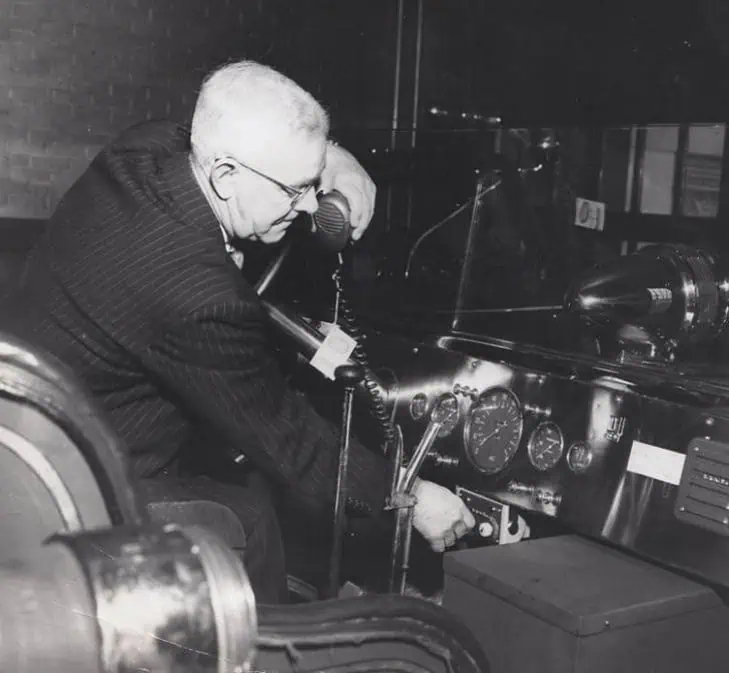
for the Ellwood City, PA, Fire Department.
Building a Control Solutions Powerhouse
The expansion that followed the rebrand signaled a deliberate shift in strategic direction. Cattron acquired Lofa Industries, Antx and DynaGen Technologies, unifying their specialized capabilities in radio remote control technology, with comprehensive engine control and monitoring technology.
That breadth is by design. Where customers once sourced engine control from one vendor, remote monitoring from another and radio remote control from a third, Cattron now provides all three as an integrated, plug-and-play offering. For OEMs and distributors, it means fewer integration headaches, a single point of accountability and a scalable architecture that can grow with their needs.
Controlling What Moves Next
Perhaps the clearest measure of Cattron’s evolution is where its technology is showing up today. The company’s wireless emergency stop systems are protecting operators working alongside autonomous guided vehicles in major distribution centers, safeguarding maintenance crews in robotic welding cells for leading automakers, and providing SIL 3-certified safety for animatronic systems at world-class theme parks. Cattron’s plug-and-play approach combines engine control panels, telemetry and monitoring, all controlled via wireless remote control, can be found on equipment and machinery at job sites around the world.
Its XBMCU multi-interface machine control unit enables wireless control and monitoring for robotic systems, semi-autonomous construction equipment, and automated manufacturing lines, supporting protocols such as PROFINET, Ethernet/IP, and dual CANbus.
These are applications that did not exist when Jim Cattron opened his radio shop 80 years ago. But the through line is unmistakable. From the first locomotive remote control system in 1977 to a wireless emergency stop worn on an operator’s belt in a fully autonomous warehouse today, to integrated engine and radio control solutions on construction and mobile equipment, Cattron’s core mission has remained the same: deliver safe, reliable and connected control solutions that keep people safe and equipment optimized.
The company has also moved proactively on cybersecurity, announcing CRA-ready products ahead of the European Union’s Cyber Resilience Act reporting deadline in September 2026. The effort reflects decades of proprietary RF development and a security-first design philosophy that, as one Cattron product manager noted during a recent interview, is “old news for Cattron” rather than a reactive measure.
80 Years and Growing
Today, Cattron operates manufacturing facilities in Warren, Ohio, and Liberec, Czech Republic. Its workforce of more than 350 employees supports nine global offices and a customer base of more than 13,000 accounts across more than 50 countries. Its trusted brands, including Remtron, DynaGen, CANplus, Tyro, Safe-E-Stop, Safe-D-Stop, CattronControl, serve markets spanning agriculture, material handling, mining, mobile equipment, industrial automation, rail, robotics and autonomous systems.
At 80, Cattron is not simply looking back. The company continues to expand its Tyro radio remote control family across North American markets, advance its XBMCU platform for industrial automation and robotics, and develop its RemoteIQ cloud infrastructure for connected equipment management into an AI-powered intelligence portal. The strategic direction is clear: deeper integration, broader protocol support and more intelligent control at every point between the operator and the machine.
“Eighty years ago, this company started by keeping radios on the air,” Wooten said. “Today, we keep global operations running, safely and reliably, in some of the most demanding environments on earth. The next 80 years will be defined by autonomy, connectivity and intelligence, and we intend to be at the center of all three.”