
Vibration Sensors Monitor and Protect Important Assets
Introduction to Cattron’s Vibration Sensors
Cattron’s advanced vibration sensors are engineered for precise asset monitoring, improved reliability and proactive maintenance planning. These sensors deliver accurate, real-time insights into machinery health, enabling predictive maintenance strategies to prevent unexpected downtime.

- Velocity Sensor (#503-2000-55): Measures vibration in inches per second (ips). It is ideal for assessing overall machinery movement and detecting gradual wear, imbalance, misalignment and loose mountings in rotating equipment.
- Acceleration Sensor (#503-2000-50): Measures vibration in gravitational units (g rms). It’s suited for high-frequency vibration detection, such as impacts, cavitation, structural fatigue and bearing failures. It’s particularly effective in industrial manufacturing.
Both sensors feature a standard 4-20mA output signal, ensuring seamless integration with CANplus™ CP750-E or CP1000 engine control panels and DynaGen™ PRO600, 410 and 350 controllers. Before integrating these sensors, ensure that your control panel firmware is current and verify that adequate analog input channels are available.
Selecting the Right Sensor and Mount for Your Application
Selecting the appropriate vibration sensor depends heavily on your specific monitoring goals and the nature of your application:
- Velocity Sensor: Best suited for monitoring general equipment health, detecting long-term wear patterns, misalignment and looseness in rotating components.
- Acceleration Sensor: Ideal for applications involving rapid vibration events or high-frequency conditions like cavitation or impact-related issues. Industries relying on critical high-speed equipment benefit most from acceleration sensors.
Sensor Comparison Table
| Sensor Type | Measurement Unit | Optimal Use | Typical Applications |
|---|---|---|---|
| Velocity Sensor | Inches per second (ips) | General machine health, gradual wear detection | Rotating machinery, alignment issues, loose mountings |
| Acceleration Sensor | g rms | High-frequency vibrations, impact detection | Cavitation, bearing degradation, structural stress detection |
Choosing the Proper Mounting Solution
Accurate vibration data collection depends significantly on proper sensor mounting. Incorrect mounting can compromise data accuracy, sensitivity and overall effectiveness. Cattron’s sensors offer multiple mounting options to match diverse installation environments:
- Stud Mount: This mount offers maximum sensitivity and reliability. It requires drilling and tapping at the installation site to ensure a secure mechanical connection and the highest data accuracy. The stud mount is the standard mount offered when purchasing a Cattron sensor.
- Adhesive Mount: Provides an effective balance between ease of installation and sensitivity, suitable when drilling isn’t practical or possible.
- Magnetic Mount: This is the quickest and easiest mounting solution, ideal for temporary monitoring or situations where repositioning is frequent. It is less sensitive than other mounting methods.
Integrating the Vibration Sensor into Your Panel
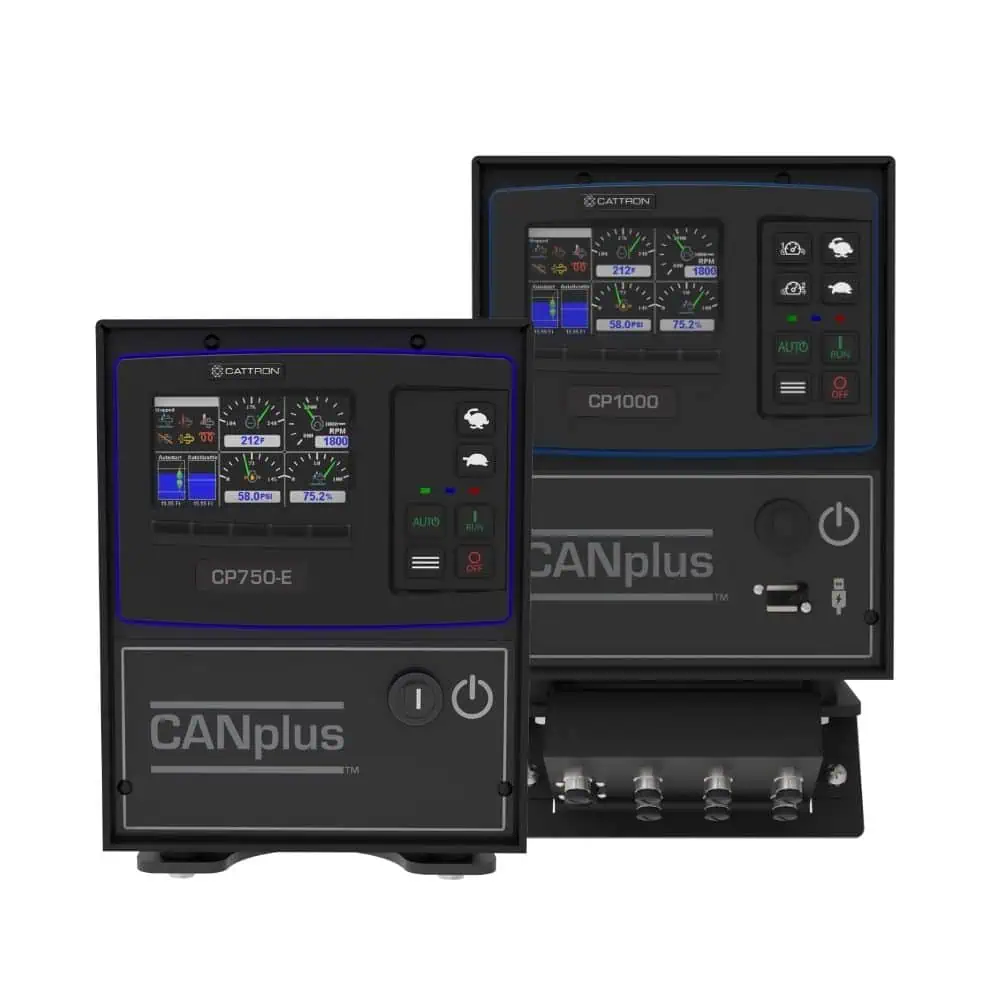
Setting Up the CP750-E or CP1000 Panel
Follow these straightforward steps to integrate vibration sensors with your CP750-E or CP1000 engine control panel:
- Connect the Sensor: Attach the sensor’s 4-20mA output to the control panel’s analog input using a compatible Cattron M12 cable.
- Configure Sensor Parameters: Select the sensor type within the panel’s interface and configure measurement units accordingly.
- Define Alarm Thresholds: Set thresholds based on recommended monitoring conditions or specific operational criteria.
- Enable Machine Learning (Optional): Using built-in machine learning capabilities, the control panel can automatically determine optimal warning levels. The learning process typically concludes within 10 minutes.
Summary
Organizations can significantly improve asset protection, minimize operational downtime, and enhance predictive maintenance outcomes by selecting the appropriate Cattron vibration sensor, applying suitable mounting methods, and correctly integrating them with CP750-E or CP1000 engine control panels. Cattron’s vibration sensors offer the precision, flexibility and reliability needed for effective, proactive asset management.