
Cutting the Cord on Safety
Why Wireless E-Stops Are the Missing Link in Robotic Operations
As autonomous systems proliferate, many OEMs and integrators still rely on fixed, hardwired emergency stops that were never designed for how robots work today, but Cattron’s wireless safety portfolio offers an alternative that many in the industry do not yet know exists.
A photograph has been making the rounds among industrial safety professionals this year. It shows a sophisticated robotic system unloading palletized boxes inside a shipping container. The robot is fast, precise and impressive. Monitoring it is a human operator, hand hovering over a fixed emergency stop button mounted to a post, watching. Just watching.
The image captures, in a single frame, the central paradox of modern industrial automation. Companies invest heavily in robotic systems to improve efficiency and reduce labor costs, then assign a person to stand next to a button, just in case. It is the kind of arrangement that made sense when robotic work cells were confined to fenced-off areas in automotive plants. It makes considerably less sense when the robot is inside a trailer, rolling autonomously through a warehouse or operating alongside untrained personnel in a distribution center.
“There are people out there who are not aware of this technology,” said Mark Densley, director of sales – Industrial Automation, Cattron. “They don’t know that you can have wireless E-stops with this level of safety certification.” At a recent industry tradeshow, Densley recounted a conversation with an engineer from a major automaker who simply did not believe that wireless emergency stop systems could achieve the same safety ratings as their hardwired counterparts.
“They can,” Densley assured him. “And increasingly, they must.”
Accessibility Problems with Hardwired E-Stops

The fundamental limitation of a hardwired emergency stop is that it requires an operator to be physically near the button when something goes wrong. In a traditional robotic work cell, that meant mounting E-stops at predictable locations around a fenced perimeter. The operator knew where the buttons were because the robot’s workspace was fixed and well defined.
That model breaks down as robotic applications expand into more dynamic environments. Autonomous guided vehicles roam freely through warehouses. Robotic arms with 20-foot reaches move at speeds that make approaching a fixed button a hazard in itself. Conveyor systems stretch across facilities where the nearest E-stop may be dozens of yards from the point of failure. In each case, the hardwired E-stop remains reliable at the point where it is mounted, but the distance between that point and the operator who needs it creates a gap that grows as automation becomes more complex.
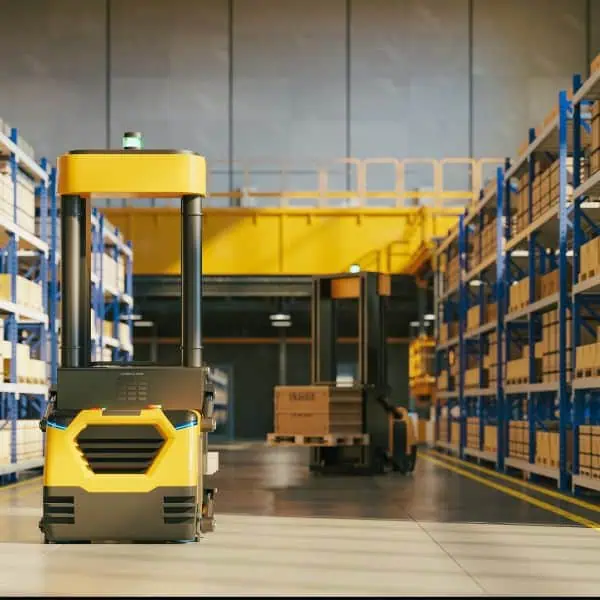
“Accessibility is the biggest challenge,” said Rebecca Weber, product manager for Cattron’s industrial solutions. “As automation gets more advanced, the risk and exposure to an operator trying to access a locally mounted E-stop increases exponentially.”
There is also a practical infrastructure concern. Wiring E-stops into robotic systems adds cost, complexity and potential failure points. One electronics manufacturer is currently deploying Cattron wireless E-stops on an entry system specifically to eliminate the expense of routing wires through the installation, removing both tripping hazards and maintenance burden in a single decision.
Two Wireless Emergency Stop Solutions, Two Safety Tiers
Cattron addresses the wireless E-stop challenge with two complementary products designed for different risk profiles and functional requirements.

The Safe-E-Stop™ is a SIL 3-certified system, evaluated and certified by TÜV Nord to the IEC 61508 standard. It consists of a personal safety device, roughly the size of a handheld radio, that clips to an operator’s belt or vest, and a machine safety device that wires in series with the existing hardwired E-stop circuit. The system delivers a typical E-stop response time of 320 milliseconds, operates at ranges exceeding 100 meters and supports up to five personal safety devices linked to a single machine safety device simultaneously. Batteries last more than 14 hours on a single charge, covering multiple shifts. The personal devices are available in five colors for easy identification across teams and zones.
The SIL 3 rating becomes particularly relevant in environments where untrained personnel may be present. In large-scale warehouse AGV deployments, for instance, the autonomous vehicles share floor space with stock workers who may have limited familiarity with the equipment. The higher safety integrity level accounts for that elevated exposure risk.
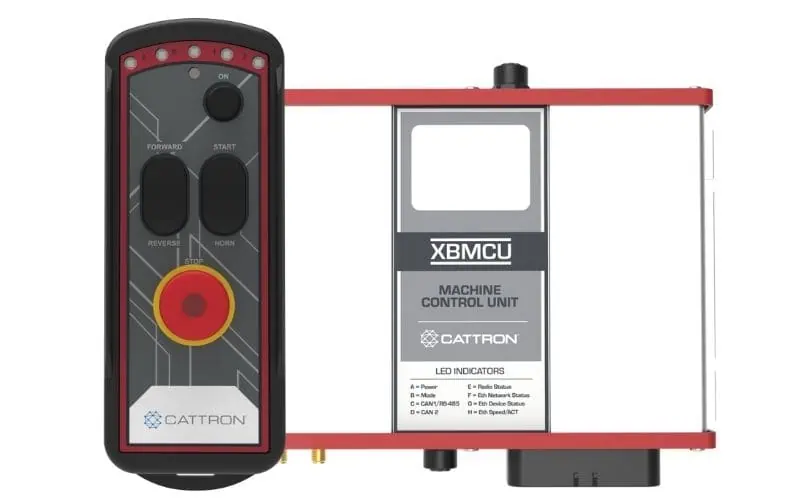
The Safe-D-Stop™ is rated to PL-d under EN/ISO 13849 and is designed specifically for machine safety applications. It shares the wireless convenience of the Safe-E-Stop but adds functionality that distinguishes it from a pure stop device. In addition to its illuminated PL-d stop switch, the Safe-D-Stop includes two PL-d reversing rocker switches that can be configured for auxiliary control functions. Its operating range extends to 180 meters, and its battery life exceeds 65 hours using standard AA alkaline batteries.
Those rocker switches open a category of use that goes well beyond emergency stopping. In AGV and autonomous forklift applications, customers are using them to execute maintenance sequences. One autonomous forklift operator programmed the full range of motion for its forklift tines through a single rocker switch press, allowing a maintenance technician to cycle the entire mechanism without returning to an HMI panel. A major shipping and logistics company uses the Safe-D-Stop exclusively as a maintenance pendant, enabling a single technician to position equipment for troubleshooting from the machine rather than requiring a second person at a remote touchscreen.
“It relieved one person from the maintenance job,” Densley said. “There were two people, one looking over the machine, troubleshooting and another at the HMI quite far away, operating it to put the machine in a maintenance position. Now one person can do it from right where they’re standing.”
The distinction between the two products maps directly to the risk assessment. PL-d is widely accepted for most industrial applications involving trained personnel. SIL 3 is specified when untrained individuals may encounter the equipment, or when the consequences of failure demand the highest integrity level. Cattron’s probability of failure for the Safe-E-Stop is certified at 1,140-11,140 years.
The Machine Side of the Emergency Stop Equation

The wireless link between operator and machine is only as useful as the receiver that translates the stop command into action. Cattron’s XBMCU multi-interface machine control unit serves as the machine-side controller for the Safe-D-Stop and significantly expands the integration picture. The XBMCU supports PROFINET, Ethernet/IP, dual CANbus and Modbus RS485, giving system integrators the protocol flexibility to deploy the same hardware whether the application uses Ethernet-based protocols common in traditional industrial automation or CAN-based protocols prevalent in mining and semi-autonomous construction equipment.
The XBMCU also enables machine-to-machine communication through Cattron’s encrypted RF protocol. In one semi-autonomous construction application, two large robotic arms operating on opposing tracks use the XBMCU to exchange sensor data in real time. If one arm detects a misalignment or timing discrepancy, the system stops the operation immediately, protecting equipment assets that can represent hundreds of thousands of dollars or more. In this case, the safety system protects not only human operators but the machines themselves.
Integration with existing safety circuits is straightforward. Cattron’s receiver wires in series with the existing hardwired E-stop circuit, appearing to the safety system as another physical stop point in the loop. The wireless device simply extends that point to wherever the operator happens to be.
Staying Connected Across Shifts
One practical challenge in 24-hour autonomous operations is managing wireless E-stops across shift changes without shutting down production. Cattron addresses this with its patented Link and D-Link process, which allows operators to safely associate and disassociate their personal E-stop devices from the safety circuit through an intentional button-press sequence. Without this capability, a wireless E-stop going offline, whether from a shift change or a battery swap, would register as a break in the circuit and halt the entire system.
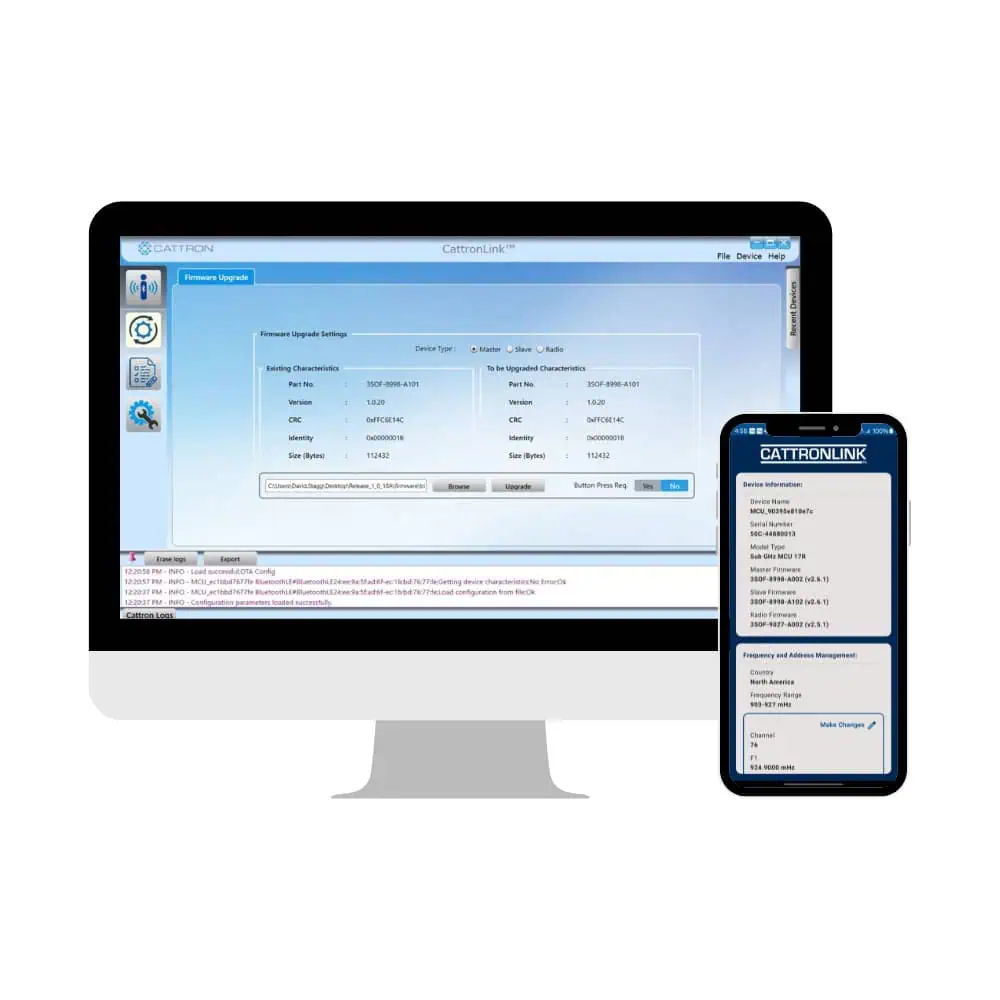
Configuration and commissioning are handled through CattronLink, Cattron’s wireless programming tool compatible with Bluetooth 5 and above. For XBMCU and CBMCU deployments, new systems can be commissioned through what Weber described as a “copy-paste mechanism,” replicating configurations across multiple AGVs or robotic cells without starting from scratch each time. For relay-based Safe-E-Stop installations, a trained technician can go from unboxing to operational in less than half a day. Cattron XBMCU-based systems with their plug-and-play two-connector interface can be even faster.
What the Market Does Not Know
When asked to identify the single most important thing robotic OEMs and system integrators should understand about wireless E-stops, both Weber and Densley gave the same answer: that the technology exists, and that it meets or exceeds the safety ratings of hardwired systems.
That awareness gap represents both a market challenge and an opportunity. Robotic work cells have expanded from automotive welding into machine tending, palletizing, warehousing, conveyor control and even autonomous vehicle marshaling, where one major automaker uses wireless E-stops to monitor electric cars that drive themselves off the assembly line and park autonomously in the yard. A leading theme park operator relies on SIL 3-rated wireless E-stops as the dedicated safety layer for autonomous animatronic characters that interact with guests, including children, at close range.
These are not edge cases. They are indicators of where automation is heading and where traditional hardwired safety systems increasingly fall short. As Weber put it, wireless E-stops represent “the key to unlocking the next generation of safe autonomous control.”
For the operator standing next to that robot with a hand hovering over a button, the message is simple: clip it to your belt, step back and let the machine do its job, while you do yours.