
From Panel to Cloud: Integrated Engine Control for Mobile Equipment
Connecting local control, wireless remote monitoring and control and cloud-based monitoring in one adaptable ecosystem.
Mobile equipment OEMs quite often need more than a standalone engine panel. Many mobile machines require local wireless remote control, remote cellular monitoring and control during typical operation. Many Mobile machines incorporate hydraulic power units, concrete pumps, generators, compressors or accompanying accessories, simplified wiring and access to operating data beyond the job site. Integrating these capabilities into a single control architecture can reduce engineering complexity while providing operators and fleet teams with more useful ways to interact with the equipment.
The Challenge of Integrated Remote Control
Engine-driven mobile equipment is becoming increasingly sophisticated. OEMs are expected to deliver machines that are easier to operate, safer, more reliable, and more connected—while simultaneously controlling development costs and reducing time to market.
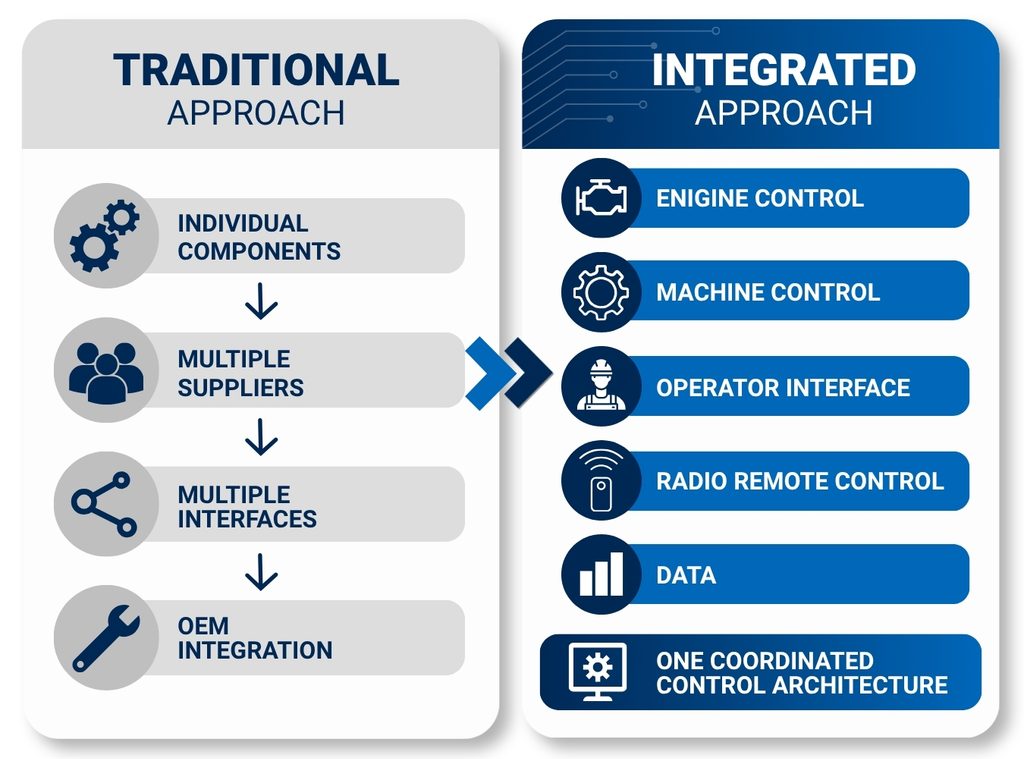
However, machine control is often assembled from multiple independent components and suppliers. Engine controls, radio remote controls, hydraulic functions, displays, sensors, I/O modules, and telematics may be selected independently and integrated later in the machine development process.
This approach can create significant challenges for OEMs:
- Multiple suppliers and points of responsibility
- Increased wiring and system complexity
- Increased wiring and system complexity
- Multiple control interfaces
- Difficult and time-consuming system integration
- Repeated engineering and configuration work
- Limited standardization between machine models
- Greater potential for communication and compatibility issues
- More difficult troubleshooting and field service
- Limited visibility into machine operation after it leaves the factory or rental fleet
- Difficulty adding new features without redesigning existing systems
For OEMs producing multiple machine models or variations, these challenges can multiply quickly.
An Integrated Approach to Engine Control

Cattron combines the control panel, remote control interfaces, wiring harnesses, I/O, and telemetry into a coordinated, plug-and-play architecture. Each layer of the system has a distinct function, but the components are engineered, configured, and tested to operate as one unified control platform. This eliminates the complexity of integrating independent components from multiple suppliers and provides OEMs with a more streamlined path from machine design through production and field support.
- Engine Control – A DynaGen™ controller manages engine start, stop and speed while displaying operating information and supporting engine protection.
- Local wired remote control – A mimic panel can reproduce essential local-panel functions at a second fixed location up to 300 feet away.
- Radio Remote Control – A Tyro™ radio remote control solution adds portable access to engine and machine commands. Radio remote controls are also available as engineered solutions to meet specific customer requirements and IO interface.
- Machine Integration – Preconfigured engine and machine harnesses connect the panel, engine, actuator, receiver and accessories while reducing field wiring and setup time.
- Telemetry – A Messenger remote monitoring device sends engine and equipment information to the RemoteIQ™ cloud platform, supporting remote visibility into equipment status, performance and usage.
A Proven Integrated Control System
Cattron combines the control panel, remote control interfaces, wiring harnesses, I/O, and telemetry into a coordinated, plug-and-play architecture. Each layer of the system has a distinct function, but the components are engineered, configured, and tested to operate as one unified control platform. This eliminates the complexity of integrating independent components from multiple suppliers and provides OEMs with a more streamlined path from machine design through production and field support.
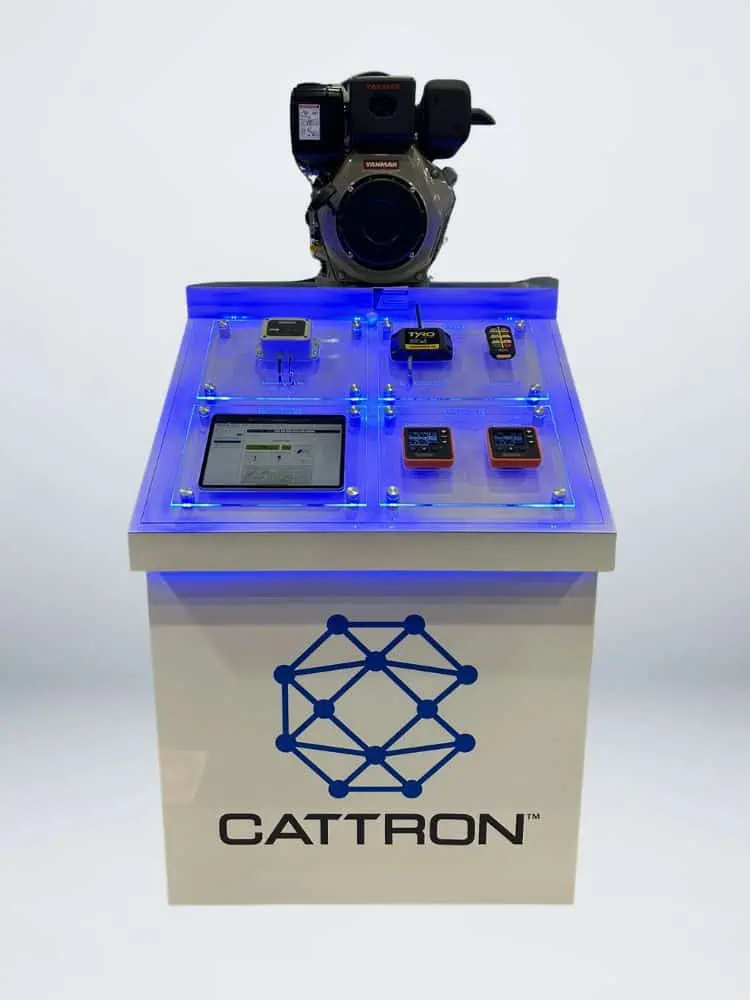
A demonstration built around a Yanmar L100 engine shows the complete control path. A local DynaGen 200 panel controls engine start, stop and speed. A mimic panel duplicates key functions at a second fixed location.
A Tyro Musca 2S handheld radio remote control extends operation beyond the panel. From the remote, the operator can start or stop the engine and increase or decrease engine speed. The same interface can be configured for machine-specific commands such as pump on/off, forward/reverse, volume adjustment, an electric clutch or lighting.
On mechanically governed engines, the control system can drive an actuator connected to the engine fuel rack. In the demonstration, a speed-up command moves the actuator toward the maximum-speed position. A speed-down command returns it toward a lower-speed position. This gives OEMs a way to add electronic control and wireless throttling to a mechanical engine.
Messenger Lite integrates with the DynaGen 200 panel and sends information to the RemoteIQ cloud platform. When the engine enters its simulated run mode, equipment status becomes available on any mobile device, extending local control to remote fleet visibility.
Remote Control Benefits for OEMs and Equipment Operators
Simpler integration. Preconfigured harnesses and a panel-ready design reduce wiring complexity and help shorten installation and commissioning time
Flexible machine control. The architecture can support electronically or mechanically governed engines as well as application-specific functions beyond the engine.
Operator mobility. Wireless control allows operators to choose a position with a clearer view of the equipment and work area while maintaining control of essential functions.
Consistent interfaces. Local, mimic and radio controls can be configured around the same operating logic, creating a more intuitive experience across control points.
Remote equipment visibility. Cloud-based information can help fleet managers and service teams review equipment health, engine performance and usage without being physically present at the machine.
Designed for Different Engines and Applications
Although the demonstration uses a Yanmar L100, the architecture can support a wide range of engine brands and mobile equipment. The DynaGen portfolio of controllers can address different engine control requirements. Tyro wireless transmitters and receivers can be selected for the required machine functions, feedback and environment.
The same panel-to-cloud approach can be adapted for pumps, hydraulic power units, mobile conveyors, agricultural equipment, construction machinery, rental equipment and other engine-driven assets. The final configuration depends on the engine interface, machine functions, environment and monitoring needs.
A Complete System Instead of Separate Components
This is the fundamental value of an integrated control strategy: the system is designed to work together from the beginning, rather than being assembled and integrated after the fact.
See the system in operation. Watch the integrated engine control demonstration. Contact Cattron to discuss an integrated system for your mobile equipment application.